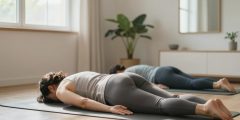
Looking for a way to boost your flexibility and balance from home? Pilates is a low-impact method that’s easy on your body. It helps you reach your fitness goals without strain.

Doing Pilates at home lets you work at your own speed. You can focus on what your body needs. A beginner pilates routine starts with simple exercises. These target your core, improve posture, and increase energy.
Adding easy pilates exercises to your day can bring many benefits. You’ll see better flexibility, balance, and overall fitness.
Key Takeaways
- Improve flexibility and balance with pilates at home
- Start with a beginner pilates routine for a safe and effective workout
- Boost energy levels and overall health with easy pilates exercises
- Practice Pilates at your own pace, in the comfort of your own home
- Enhance overall physical fitness with pilates workouts for beginners
What is Pilates and Why Should You Try It?
Pilates is a fitness method from the early 20th century. It’s known for its holistic health approach. It strengthens the body, boosts flexibility, and improves mental health through controlled movements and breathing.
The Origins and Philosophy of Pilates
Joseph Pilates created this method, calling it “Contrology.” It links physical movement with mental focus. Pilates aims to unite body, mind, and spirit through exercises that build strength, flexibility, and awareness.
Key Benefits for Mind and Body
Pilates is great for both physical and mental health. Here are some key benefits:
Physical Benefits
- Improved Flexibility: Pilates stretches and lengthens muscles.
- Core Strength: It strengthens the core, vital for stability and balance.
- Better Posture: It enhances posture by strengthening spine-supporting muscles.
Mental Benefits
- Reduced Stress: It lowers stress through breathing and controlled movements.
- Improved Concentration: Pilates sharpens focus and mental clarity.
| Benefits | Physical | Mental |
|---|---|---|
| Improved Flexibility | ✔ | |
| Core Strength | ✔ | |
| Reduced Stress | ✔ | |
| Improved Concentration | ✔ |

Adding Pilates to your fitness routine can bring these benefits to life. Enjoy a healthier, more balanced lifestyle.
Who Can Benefit from Home Pilates for Beginners
Pilates is a flexible exercise that fits many fitness needs and goals. This makes it great for lots of people.
Fitness Levels and Age Considerations
Pilates works for all ages and fitness levels. It’s perfect for young adults wanting to boost their core strength or older adults looking for easy exercises. It’s especially good for beginners or those coming back to exercise. The slow, controlled moves build strength, boost flexibility, and better overall fitness.
Pilates for Rehabilitation and Injury Prevention
Pilates is great for recovery because it’s low-impact and focuses on controlled movements. It strengthens muscles around injuries without too much strain. Pilates also helps prevent injuries by making you more flexible, balanced, and aware of your body.

Complementing Other Exercise Routines
Pilates is a great addition to other workouts like running, swimming, or weightlifting. It enhances core strength, flexibility, and body alignment. Many athletes add Pilates to their training to get fitter and avoid injuries.
Creating Your Perfect Home Pilates Space
To get the most out of your home Pilates practice, setting up a dedicated space is key. You don’t need a large area. Even a small, well-organized corner can be ideal.
Space Requirements and Setup
When setting up your home Pilates space, consider the size of the room and the type of exercises you plan to do. A minimum of 6 feet by 6 feet is recommended to allow for free movement. Make sure the floor is smooth and non-slippery. Consider using a good quality exercise mat.
Essential Equipment vs. No-Equipment Options
Pilates can be practiced with or without equipment. The choice depends on your personal preference, budget, and available space.
Beginner-Friendly Equipment
For those who prefer using equipment, resistance bands and Pilates balls are great for beginners. They are affordable, versatile, and can enhance your workout.
No-Equipment Alternatives
If you prefer not to use equipment, you can still have an effective Pilates practice. Focus on mat exercises that use your body weight for resistance.

Ultimately, the best home Pilates space is one that is quiet, comfortable, and free from distractions. By considering your space and equipment needs, you can create an environment that supports your practice and helps you achieve your fitness goals.
The Six Core Principles of Pilates
Learning the six core principles of Pilates is key for a safe and effective workout. These principles are the base of Pilates. They guide every move to ensure you get the most benefit and avoid injury.
The six core principles are: concentration, control, centering, precision, breath, and flow. Each one is important in Pilates. Together, they make a complete way to improve your physical fitness.
Concentration and Control
Concentration means focusing your mind on the exercise. It helps you do it right and use the right muscles. Control is about doing movements with precision and purpose. It means avoiding sudden or uncontrolled actions.
Centering and Precision
Centering is about using your core muscles to support your movements. It gives you stability and strength. Precision is about doing exercises with exactness. It ensures each movement is done correctly and effectively.
Breath and Flow
Breath is key in Pilates. It helps you move in sync and relax. Flow means moving smoothly from one exercise to another. It creates a continuous and fluid motion.
| Pilates Principle | Description |
|---|---|
| Concentration | Focusing the mind on the exercise |
| Control | Executing movements with precision and intent |
| Centering | Engaging core muscles for stability |
| Precision | Performing exercises with exactness |
| Breath | Synchronizing movement with breathing |
| Flow | Moving smoothly between exercises |
By understanding and using these six core principles, you can improve your Pilates practice. You’ll get better results and a more balanced fitness approach.

Mastering the Pilates Fundamentals
Learning the basics of Pilates is key for a safe and effective workout. Knowing these fundamentals helps you get the most from your Pilates practice. By mastering proper technique, you can enjoy all the benefits Pilates has to offer.
Proper Breathing Technique
Proper breathing is a key part of Pilates. It helps engage your core, relax your mind, and improve your physical performance. To breathe right, inhale deeply through your nose and exhale slowly through your mouth.
Finding Neutral Spine Position
Keeping your spine neutral is crucial for safety and effective movement. To find your neutral spine, imagine a straight line from your head to your heels. Your lower back should have a slight inward curve. This helps your spine absorb shock and distribute stress evenly.
Engaging Your Core Correctly
Correctly engaging your core is vital for stability, balance, and strength. To engage your core, pull your navel towards your spine while keeping your pelvic floor relaxed. This builds a strong base for your Pilates practice.

| Fundamental | Description | Benefits |
|---|---|---|
| Proper Breathing Technique | Inhaling deeply through the nose and exhaling slowly through the mouth | Relaxes the mind, engages the core, and enhances physical performance |
| Neutral Spine Position | Maintaining a straight line from head to heels with a slight inward curve in the lower back | Prevents injuries, ensures effective movement, and distributes stress evenly |
| Core Engagement | Drawing the navel towards the spine while maintaining a relaxed pelvic floor | Builds stability, balance, and overall strength |
10 Essential Pilates Exercises for Beginners
Starting with Pilates can feel daunting, but learning these 10 key exercises will give you a solid base. Pilates is great for boosting flexibility, strength, and body control. It’s perfect for anyone looking to get fit.
These exercises focus on your core, improve your posture, and boost your fitness. Let’s take a closer look at each one.
The Hundred
The Hundred is a basic Pilates move that works your core and encourages deep breathing. Start by lying on your back with arms by your sides and legs up at a 90-degree angle. Move your arms up and down while breathing deeply, holding for 100 beats.
Roll-Ups and Roll-Downs
Roll-Ups and Roll-Downs target your abs and improve spine flexibility. For Roll-Ups, lie on your back with arms up and slowly move up to a seated position, then back down. Roll-Downs start seated and roll down to the mat.
Single Leg Circles
Single Leg Circles enhance hip mobility and strengthen your legs. Lie on your back with one leg up and the other bent or straight. Move the leg in circles, first clockwise, then counterclockwise.
Spine Stretch Forward
The Spine Stretch Forward is a seated move that stretches your spine and hamstrings. Sit with legs straight out, inhale to extend your spine, and exhale to stretch forward, reaching for your toes.
Single Leg Stretch and Double Leg Stretch
Single Leg Stretch and Double Leg Stretch strengthen your core. For Single Leg Stretch, lie on your back and alternate bringing one knee to your chest while extending the other. Double Leg Stretch brings both knees to your chest, then extends both legs.

The Bridge and Shoulder Bridge
The Bridge targets your glutes and hamstrings. Lie on your back with knees bent and feet flat, then lift your hips up. For a Shoulder Bridge, lift your hips even higher, using your shoulders and feet for support.
The Swan and Swimming
The Swan and Swimming strengthen your back. For The Swan, lie on your stomach with arms extended, then lift your arms, chest, and legs. Swimming involves lying on your stomach and moving your arms and legs in a swimming motion.
| Exercise | Primary Muscle Group | Benefits |
|---|---|---|
| The Hundred | Core | Improves core strength, promotes deep breathing |
| Roll-Ups/Roll-Downs | Abdominals | Enhances flexibility, strengthens abdominals |
| Single Leg Circles | Legs, Hips | Improves hip mobility, strengthens legs |
These 10 essential Pilates exercises for beginners will help you build a strong foundation for your practice. They improve your overall fitness and well-being. As you get better, you can make these exercises harder or add new ones to keep challenging yourself.
“Pilates is not just a workout, it’s a way of life that integrates body, mind, and spirit.” –
Beginner-Friendly Home Pilates Routines
Starting Pilates at home can be both exciting and a bit scary. But with the right routines, you can do great. Pilates is great for all fitness levels and goals.
10-Minute Morning Energizer Routine
A 10-minute morning routine can make you feel more awake and ready for the day. Start with some gentle stretches. Then do The Hundred and Leg Circles to get your blood moving.
15-Minute Core Strengthening Sequence
Having a strong core is key in Pilates. This sequence includes Plank variations, Single Leg Stretch, and Double Leg Stretch. These exercises work your core muscles well.
20-Minute Full Body Workout
A full-body workout in Pilates works many muscle groups. It’s divided into three parts:
Warm-up Sequence
- Leg Swings
- Arm Circles
- Neck Stretch
Main Exercises
| Exercise | Repetitions | Focus |
|---|---|---|
| Roll-Ups | 10 | Abdominal Strength |
| Single Leg Stretch | 15 (each leg) | Core Engagement |
| The Bridge | 10 | Gluteal Strength |
Cool Down
End with gentle stretches like Spine Stretch Forward and Seated Forward Bend. These help relax your muscles.

These routines are made to be flexible. You can adjust them to fit your comfort and fitness level. Stick to it, and pick a routine that works for you.
Common Mistakes and How to Avoid Them
Knowing the common Pilates mistakes helps you practice better and safer. Being aware of these issues ensures a productive and injury-free workout.
Improper Form and Alignment Issues
One big mistake in Pilates is bad form and alignment. This can make exercises less effective and might hurt you. To fix this, keep your spine straight and use your core muscles. Right alignment is crucial for the best results from each move.

Breathing Errors to Watch For
Breathing is key in Pilates, and wrong breathing can mess up your workout. Mistakes include holding your breath or breathing too lightly. Learn to breathe deeply and control it to get the most from Pilates.
“The way you breathe is closely linked to your state of mind and the way you move.” – Joseph Pilates
Overexertion and Pushing Too Hard
Overdoing it is a common error, especially for newbies. It’s important to listen to your body and not go too far. Pilates is about smooth, precise movements, not forcing your body into hard positions.
| Common Mistake | How to Avoid It |
|---|---|
| Improper Form | Focus on neutral spine and engage core |
| Breathing Errors | Practice deep, controlled breathing |
| Overexertion | Listen to your body and don’t push too hard |
By watching out for these mistakes and avoiding them, you can improve your Pilates and see better results.
Progressing Your Home Pilates Practice
As you get more comfortable with home Pilates, it’s key to challenge yourself. This helps you reach your fitness goals and keeps your practice fun and interesting.
When and How to Increase Difficulty
Increasing the difficulty in Pilates should be done carefully. Pay attention to your body and only add more challenge when you’re ready. You can do this by adding more reps, deepening your movements, or trying more complex exercises.
For example, if you’ve mastered the Single Leg Stretch, try the Double Leg Stretch or add more leg circles.
Adding Variations to Basic Exercises
Adding new twists to your Pilates routine can target different muscles and prevent boredom. For instance, you can change the Plank by lifting your legs or add a leg lift to your Bridge pose. Here are some variations to try:
- Modify the Hundred by lifting your legs higher or holding for longer
- Add a twist to your Spine Stretch Forward for an oblique workout
- Try Single Leg Circles with a resistance band for added challenge
Incorporating Pilates Equipment Over Time
As you get better, using Pilates equipment like a Reformer or Resistance Bands can be helpful. These tools add variety and challenge to your workouts. Start with easy equipment and move to harder ones as you get more comfortable.
Resources to Support Your Pilates Journey
Starting your Pilates journey? The right tools can really help. You can find many resources to fit your needs and goals.
Recommended Online Classes and Videos
Online classes and videos make Pilates easy to do at home. Sites like Blogilates and Pilates Anytime have classes for all levels. You can also find free Pilates videos on YouTube, covering everything from basics to advanced moves.
Helpful Books and Apps
Books and apps can also support your Pilates practice. “The Pilates Bible” by Celia Larson is a great guide. Apps like Pilates by Daily Burn and Fitstar Pilates offer workouts and tracking to keep you on track.
When to Consider Working with an Instructor
Self-practice is good, but a certified instructor can really help. If you’re new or need to work on specific issues, consider getting professional help.
Conclusion: Embracing the Pilates Lifestyle
This Pilates for beginners guide shows that Pilates is more than a workout. It’s a journey to better health. By adding a beginner Pilates workout to your day, you start living the Pilates lifestyle.
Pilates brings many benefits, like stronger core and better flexibility. It also helps with posture and lowers stress. As you keep practicing, you’ll see big improvements in your health and mind.
Consistency is crucial to enjoy Pilates fully. Regular practice lets you see its amazing effects. It makes your life healthier and more balanced. Stay excited and keep going, whether you’re doing beginner or advanced Pilates.
Think about using online classes or Pilates gear to help your practice. Embracing Pilates as a lifestyle means investing in your health and well-being. It connects you deeply with your body and mind.