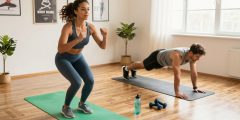
Did you know 15 minutes of High-Intensity Interval Training can be as good as 45 minutes of steady cardio? This shows how effective HIIT exercises are for losing weight and improving heart health.
HIIT Exercises mix short, intense workouts with brief breaks. This not only increases your metabolism but also helps your body burn fat better. With effective at-home HIIT workouts, you can get fit without going to the gym.

This article will show you quick home HIIT routines great for beginners. You’ll learn to make your own high-intensity interval training sessions that match your schedule and fitness level.
Key Takeaways
- Understand the benefits of HIIT Exercises for weight loss and overall fitness.
- Learn simple HIIT workouts that can be done at home with minimal equipment.
- Discover how to create effective at-home HIIT workouts tailored to your fitness level.
- Explore quick home HIIT routines that fit into your busy schedule.
- Get tips on how to stay motivated and track your progress with HIIT Exercises.
The Rising Popularity of At-Home HIIT Workouts
At-home HIIT workouts have become very popular. They offer a convenient and effective way to stay fit. This change is because people want flexible and efficient ways to exercise that fit into their busy lives.
Why HIIT Has Become a Fitness Phenomenon
HIIT has become a hit in fitness because it’s time-efficient and highly effective. It involves short, intense workouts followed by brief rests. This way, people can burn a lot of calories and improve their heart health quickly.

The Shift to Home-Based Fitness Solutions
More people are choosing home-based fitness because it’s convenient and flexible. With home HIIT routines, you can exercise at home. This means no need to go to the gym and more control over your workout space.
| Benefits of At-Home HIIT Workouts | Traditional Gym Workouts |
|---|---|
| Convenience and flexibility | Fixed schedules and commute time |
| Cost-effective with minimal equipment | Membership fees and equipment costs |
| Personalized workout environment | Shared gym space with distractions |
Understanding the Science Behind HIIT
HIIT’s science shows it boosts calorie burn and fitness. It mixes short, intense exercises with brief rests or low-intensity ones.

How HIIT Accelerates Calorie Burning
HIIT boosts calorie burning by raising energy use during and after exercise. It uses both aerobic and anaerobic systems, increasing the metabolic rate.
HIIT’s intense workouts keep the body burning calories long after exercise ends. This makes it great for fat-burning workouts.
The Afterburn Effect: EPOC Explained
The afterburn effect, or EPOC, is when the body uses more oxygen after intense exercise. It’s needed to refill energy, repair muscles, and get back to rest.
EPOC is crucial for HIIT’s weight loss and fat-burning success. It’s the extra calories burned after the workout.
Simple HIIT Workouts at Home: An Overview
Looking for a quick way to stay fit? Simple HIIT workouts at home are perfect. High-Intensity Interval Training (HIIT) is known for its fast results, ideal for those with tight schedules.

These workouts are both efficient and effective. They help you see fitness gains without spending hours exercising. This is great for those wanting to boost their health and fitness.
Time Efficiency: Maximum Results in Minimal Time
One big plus of simple HIIT workouts is how quickly they work. They mix short, intense exercises with brief rests. This way, you get a great workout fast, saving time and keeping your metabolism up for hours.
Metabolic Advantages Over Traditional Cardio
HIIT workouts also have big metabolic benefits. They make your body work hard, burning more calories during and after. This means you keep burning calories even after you’re done exercising.
Adaptability for All Fitness Levels
HIIT workouts are also super adaptable. They fit anyone, from beginners to advanced athletes. You can adjust the intensity and exercises to match your fitness level and goals.
In short, simple HIIT workouts at home are a great choice. They’re quick, boost your metabolism, and can be tailored to your fitness level. Adding them to your routine can lead to big health and fitness gains without needing to spend hours at the gym.
Essential Equipment for Home HIIT Sessions
HIIT workouts at home don’t need much equipment. This flexibility makes HIIT easy for everyone to do. You can create great workouts with just a few things.
HIIT is great because you can do it anywhere, even at home. It’s popular because you don’t have to spend a lot on gear.
No-Equipment HIIT Options
One big plus of HIIT is you can do it without any equipment. You can use bodyweight exercises like squats, lunges, and push-ups. These exercises are good for your strength and heart health.
Bodyweight exercises like burpees and mountain climbers are also great. They’re effective and don’t take up much space, perfect for home workouts.
Basic Tools to Enhance Your Workouts
Even though you don’t need equipment, some basic tools can make your HIIT workouts better. Things like dumbbells, resistance bands, or a jump rope can add variety. They can also make your workouts more intense and target different muscles.
Dumbbells can make squats and lunges harder. Resistance bands are great for upper body exercises. A jump rope is excellent for cardio.

| Equipment | Benefits | Examples |
|---|---|---|
| No Equipment | Cost-effective, space-saving | Bodyweight squats, push-ups |
| Dumbbells | Adds resistance, versatile | Dumbbell squats, deadlifts |
| Resistance Bands | Portable, easy to use | Banded squats, banded push-ups |
| Jump Rope | Improves cardio, coordination | High-intensity interval jumping |
Beginner-Friendly HIIT Routines
Beginner-friendly HIIT workouts are great for newbies. They help ease into a more intense fitness routine. These workouts are perfect for those just starting with high-intensity interval training or looking for a less intimidating way to get started.
Starting with beginner-friendly HIIT routines allows individuals to build confidence and endurance. It’s essential to begin with workouts that are manageable. Then, gradually increase the intensity as you become more comfortable.
10-Minute Starter HIIT Workout
A 10-minute starter HIIT workout is an excellent way to begin your fitness journey. This duration is short enough to keep you engaged but long enough to challenge your body. Here’s a simple routine:
- 30 seconds of jumping jacks
- 30 seconds of rest
- 30 seconds of mountain climbers
- 30 seconds of rest
- 30 seconds of burpees
- 30 seconds of rest
- Repeat the cycle for 10 minutes

Modifications for Complete Beginners
For complete beginners, it’s crucial to modify HIIT workouts to suit your fitness level. This can include reducing the duration of the workout intervals or substituting high-impact exercises with lower-impact alternatives.
For example, you can replace burpees with squat jumps or modify mountain climbers to a slower pace. The key is to listen to your body and adjust the intensity accordingly.
Effective Bodyweight HIIT Exercises
Bodyweight HIIT exercises are great for working out at home or on the go. They challenge your body, boosting heart health, strength, and endurance.

Upper Body HIIT Movements
Upper body HIIT exercises are key for building muscle and endurance. Burpees, push-ups, and mountain climbers work many muscles at once. They offer a tough workout that boosts upper body strength.
Lower Body Power Exercises
Lower body exercises are vital for stronger legs and better endurance. Squat jumps, lunges, and glute bridges are great for HIIT. They not only build strength but also increase your metabolism.
Core-Focused HIIT Exercises
Core exercises are essential for better stability and athletic performance. Plank jacks, Russian twists, and bicycle crunches are very effective. A strong core helps with other exercises and lowers injury risk.
| Exercise | Target Area | Repetitions |
|---|---|---|
| Burpees | Full Body | 15-20 |
| Push-ups | Upper Body | 10-15 |
| Squat Jumps | Lower Body | 12-18 |
| Plank Jacks | Core | 20-30 |
Structured 20-Minute HIIT Workout Plans
A 20-minute HIIT workout can be just as good as longer cardio sessions. HIIT mixes short, intense exercises with brief rests. This combo burns lots of calories and boosts heart health.
Having a structured plan is key to getting the most out of HIIT. Here are two 20-minute HIIT routines you can add to your workout routine.
Full-Body HIIT Circuit
This circuit works out many muscles at once, giving you a full-body workout. Here’s how to do it:
- Jumping jacks: 30 seconds
- Push-ups: 30 seconds
- Squats: 30 seconds
- Mountain climbers: 30 seconds
- Rest: 30 seconds
Keep going for 20 minutes, tweaking the intensity and breaks as you see fit.
| Exercise | Duration | Rest |
|---|---|---|
| Jumping jacks | 30 seconds | 30 seconds |
| Push-ups | 30 seconds | 30 seconds |
| Squats | 30 seconds | 30 seconds |
| Mountain climbers | 30 seconds | 30 seconds |
Tabata-Style HIIT Routine
Tabata is a HIIT method with 20 seconds of hard work and 10 seconds of rest. This pattern is done for 4-6 rounds. Here’s a Tabata routine:
- Sprints: 20 seconds of sprinting followed by 10 seconds of rest
- Burpees: 20 seconds of burpees followed by 10 seconds of rest

Advanced HIIT Techniques for Greater Calorie Burn
Advanced HIIT methods can really up the calorie burn for even the top athletes. They offer more complex and tough protocols. This helps people break through fitness plateaus and reach new heights.
Pyramid HIIT Intervals
Pyramid HIIT intervals change the intensity or time of workout bursts. You might start with 30 seconds of intense exercise, then rest for 30 seconds. Next, you do 45 seconds of exercise, and so on.
This method pushes your body in new ways. It’s great for boosting your heart health and burning calories.
EMOM (Every Minute On the Minute) Workouts
EMOM workouts mean doing a set of exercises at the start of each minute. For example, you might do 10 burpees at the minute’s start, then rest for the rest of the minute.
This approach lets you do a lot of work while still getting breaks. It’s perfect for increasing calorie burn and building muscle endurance.
Using these advanced HIIT techniques can make your workouts more interesting. It helps you keep pushing towards your fitness goals.
Proper Form and Safety Guidelines
Proper form and safety are key for a good HIIT workout. It’s important to mix intensity with the right technique. This helps avoid injuries and gets the best results.
Common HIIT Exercise Form Mistakes
Poor posture is a big mistake in HIIT workouts. It can cause injuries and make exercises less effective. For instance, keeping a straight back and using your core during burpees is crucial.
Another mistake is not warming up enough. This can lead to muscle strains. A good warm-up includes dynamic stretches to get muscles ready for intense work.
| Exercise | Common Mistake | Correct Form |
|---|---|---|
| Burpees | Rounding the back | Keep back straight, engage core |
| Squats | Letting knees extend past toes | Keep knees behind toes, lower body controlled |
Injury Prevention Strategies
Preventing injuries is crucial for a successful HIIT program. This means listening to your body and not overdoing it. Doing cool-down stretches after workouts helps prevent soreness and boosts flexibility.
Also, staying hydrated and eating right helps muscles recover and improves performance.
“The most important thing in exercise is to never compromise form for speed or weight. Sacrificing form can lead to serious injuries that not only halt your progress but also have long-term health implications.”
Adapting HIIT for Different Fitness Goals
HIIT is great for many fitness goals, like losing weight or toning muscles. You can change the workout’s intensity, how long it lasts, and the exercises to fit your goals.
HIIT for Weight Loss vs. Muscle Toning
For losing weight, choose high-intensity exercises that burn lots of calories. Try sprint intervals or burpees. For toning muscles, pick exercises that work on specific muscles, like squat jumps or mountain climbers.
| Fitness Goal | Example Exercises | Intensity Level |
|---|---|---|
| Weight Loss | Sprint intervals, Burpees | High |
| Muscle Toning | Squat jumps, Mountain climbers | Moderate to High |
Customizing Intensity for Your Fitness Level
Make sure to adjust the workout’s intensity based on your fitness level. Start with lower intensity if you’re new to HIIT. As you get better, increase the intensity with harder exercises.
Tracking Progress and Maintaining Motivation
Starting your HIIT journey means learning to track your progress and stay motivated. It’s a big challenge, but with the right strategies, you can beat it and reach your fitness goals.
Metrics to Monitor During HIIT Workouts
To track your HIIT progress, watch your workout duration, exercise completion rate, and heart rate monitoring. These metrics give you insights into how you’re doing. For example, heart rate tracking shows if you’re at the right intensity.
Overcoming Plateaus and Staying Consistent
Plateaus happen, but they shouldn’t stop you. To get past them, change your workout routine by adding new exercises or making it harder. Also, setting realistic goals and celebrating small wins keeps you motivated. Staying consistent is crucial for lasting success in HIIT.
Conclusion: Making HIIT a Sustainable Part of Your Fitness Journey
Adding HIIT to your workout routine can really change your health and wellness. It’s all about understanding HIIT, picking the right exercises, and adjusting the intensity to fit your level. This way, you can enjoy the lasting benefits and reach your fitness goals.
To keep HIIT a regular part of your life, it’s key to stick to it. Begin by adding HIIT sessions to your daily planner, just like any other important meeting. As you get better, try new exercises and increase the intensity to keep improving.
When you mix HIIT with a healthy diet and lifestyle, you’ll see big improvements in your fitness and health. With a consistent HIIT practice, you’re on the path to lasting fitness and all its benefits. This makes HIIT a great choice for long-term fitness success.